• Skip to main content
  • Skip to secondary menu
  • Skip to primary sidebar
  • Skip to footer
  • Home
  • Who we are
    • What we think
      • Positions
      • Members’ and friends’ contributions
    • What we do
      • Past-Campaigns
      • Upcoming Events
      • Annual Event
      • Past Events
        • General Assembly
      • Environmental Observatory
      • “PAROS 2020” & Tourism Survey
        • Paros Tourism Survey 2012
        • Paros Tourism Survey 2013
  • The Bulletins
    • Issue 30 – spring 2026
    • 2025
      • Issue 29 – summer 2025
      • Issue 28 – spring 2025
    • E-Bulletin Autumn 2024
    • 2023
      • E-Bulletin issue 26 – 2023
      • E-Bulletin Issue 25 – 2023
    • 2022
      • E-Bulletin Issue 24 – Spring 2022
      • E-Bulletin Ιανουάριος/January/Janvier 2022
    • 2021
      • E-Bulletin Issue 23 – Autumn 2021
      • E-Bulletin Issue 22 – Summer 2021
    • 2020
      • Issue 21 – Year 2020
    • 2019
      • E-Bulletin Winter 2020
      • Issue 20 – Summer 2019
      • Issue 19 – Spring 2019
    • 2018
      • Issue 18 – Winter 2018
      • Issue 17 – Summer 2018
      • Issue 16 – Spring 2018
        • articles en francais
        • articles in english
    • 2017
      • Issue 15 – Winter 2017-18
        • articles en Français
        • articles in English
      • Issue 14 – Summer 2017
        • articles en Français
        • articles in English
      • Issue 13 – Spring 2017
        • articles en Français
        • articles in English
    • 2016
      • Issue 12 – Winter 2016-17
        • articles en Français
        • articles in English
      • Issue 11 – Summer 2016
        • articles en Français
        • articles in English
      • Issue 10 – Winter-Spring 2016
        • articles en Français
        • articles in English
    • 2015
      • Issue 09 – Summer 2015
        • articles en Français
        • articles in English
    • 2014
      • Issue 08 – Summer 2014
        • articles en Français
        • articles in English
    • 2013
      • Issue 07 – Summer 2013
        • articles in English
        • articles en Francais
    • 2012
      • Issue 06 – Summer 2012
      • Issue 05 – Spring 2012
    • 2011
      • Issue 04 – Summer 2011
    • 2010
      • Issue 03 – Autumn 2010
      • Issue 02 – Summer 2010
      • Issue 01 – Winter 2009-10
  • Workshops
    • Στρατηγικές για την Αειφορία 2023
    • Health on Paros / Υγεία στην Πάρο / Santé à Paros
      • Workshop on Health – 14.12.2019
      • Atelier sur la Santé – 14.12.2019
      • Ημερίδα για την Υγεία – 14.12.2019
    • Ancient Quarries Workshop
      • Conclusions
      • Conclusions (français)
      • Ομιλίες / Interventions
  • Current & older Issues
    • overconstruction
    • overtourism
    • Marathi Quarries
    • sustainable development
    • Sustainable Tourism
      • Στρατηγικές για την Αειφορία 2023
      • “PAROS 2020” & Tourism Survey 2012-2014
        • Paros Tourism Survey 2012
        • Paros Tourism Survey 2013
    • Airport
    • Wind Parks
  • Events

Friends of Paros & Antiparos Φίλοι της Πάρου & Αντιπάρου Amis de Paros & Antiparos

Sustainable development for Paros & Antiparos Islands

friends of paros & antiparos
  • Ελληνικα >>
  • Ποιοι Ειμαστε
    • Τι πιστευουμε
      • Θέσεις
      • Συμβολή μελών και φίλων
    • Τι κάνουμε
      • Ετήσιες Τελετές
    • Καμπάνιες
  • Τα “Bulletins”
    • Ε-Bulletin 2024 – άρθρα στα ελληνικά
    • 2023
      • E-Bulletin 25 -2023 – άρθρα στα ελληνικά
    • 2022
      • Τεύχος 24 – 2022 – άρθρα στα ελληνικά
      • E-Bulletin Ιανουάριος 2022
    • 2021
      • Τεύχος 23 – 2021 – άρθρα στα ελληνικά
      • Τεύχος 22 – 2021 – άρθρα στα ελληνικά
    • 2020
      • Τεύχος 21 – Έτος 2020 – άρθρα στα ελληνικά
    • 2019
      • Χειμώνας 2019-20 – άρθρα στα ελληνικά
      • Τεύχος 20 – Καλοκαίρι 2019 – άρθρα στα ελληνικά
      • Τεύχος 19 – Άνοιξη 2019 – άρθρα στα ελληνικά
    • 2018
      • Τεύχος 18 – Χειμωνάς 2018 – άρθρα στα ελληνικά
      • Τεύχος 17 – Καλοκαίρι 2018 – άρθρα στα ελληνικά
      • Τεύχος 16 – Άνοιξη 2018 – άρθρα στα ελληνικά
    • 2017
      • Τεύχος 15 – Χειμώνας 2017-2018 – άρθρα στα ελληνικά
      • Τεύχος 14 – Καλοκαίρι 2017- άρθρα στα ελληνικά
      • Τεύχος 13 – Άνοιξη 2017- άρθρα στα ελληνικά
    • 2016
      • Τεύχος 12 – Χειμωνας 2016-17- αρθρα στα ελληνικα
      • Τεύχος 11 – Καλοκαίρι 2016- άρθρα στα ελληνικά
      • Τεύχος 10 – Χειμώνας-Άνοιξη 2016- άρθρα στα ελληνικά
    • 2015
      • Τεύχος 9 – Καλοκαίρι 2015- άρθρα στα ελληνικά
    • 2014
      • Τεύχος 8 – Καλοκαίρι 2014- άρθρα στα ελληνικά
    • 2013
      • Τεύχος 7 – Καλοκαίρι 2013- άρθρα στα ελληνικά
    • 2012
      • Τεύχος 6 – Καλοκαίρι 2012- άρθρα στα ελληνικά
      • Τεύχος 5 – Άνοιξη 2012- άρθρα στα ελληνικά
    • 2011
      • Τεύχος 4 – Καλοκαίρι 2011- άρθρα στα ελληνικά
    • 2010
      • Τεύχος 3 – Φθινόπωρο 2010- άρθρα στα ελληνικά
      • Τεύχος 2 – Καλοκαίρι 2010- άρθρα στα ελληνικά
      • Τεύχος 1 – Χειμώνας 2009-10 – άρθρα στα ελληνικά
  • Contact FoP
    • Membership application . Αίτηση Εγγραφής . Demande d’Adhésion
    • Register to contribute / Inscrivez-vous pour contribuer / Εγγραφείτε για να συμβάλετε
    • Login
  • Ημεριδες
    • Στρατηγικές για την Αειφορία 2023
    • Ημερίδα για την Υγεία – 14.12.2019
    • Ημερίδα για τα Αρχαία Λατομεία
      • Ομιλίες / Interventions
      • Τα συμπεράσματα της ημερίδας – Δελτίο Τύπου
  • Τρεχοντα ζητηματα
  • Εκδηλώσεις
Members' and friends' contributions » Swimming Pools in Paros: A Luxury the Island Can No Longer Afford

Swimming Pools in Paros: A Luxury the Island Can No Longer Afford

20 May 2026, by Orphée Vardos No Comments

Ελληνικά | Français

An island under water stress

Paros is a semi-arid Mediterranean island with structurally limited freshwater resources. Its groundwater tables are sometimes less than 40 centimeters above sea level, and the summer population multiplies the demand for water several times over on an already fragile infrastructure. The municipal water authority (ΔΕΥΑΠ) produces between 2.5 and 2.6 million m³ of drinking water per year, increasingly relying on desalination—a costly and energy-intensive technology.

This document follows a December 2025 FoPA report on water supply management. This time, it addresses a source of avoidable and poorly regulated demand: private swimming pools.

I) The Legal Problem: “Ghost Pools”

The 2012 Paros General Urban Plan explicitly prohibits swimming pools in out-of-plan areas for residences. However, systematic circumvention of these regulations has been documented: hundreds of pools are registered under false designations—“decorative water features” or “agricultural reservoirs”—to avoid building permits and footprint calculations.

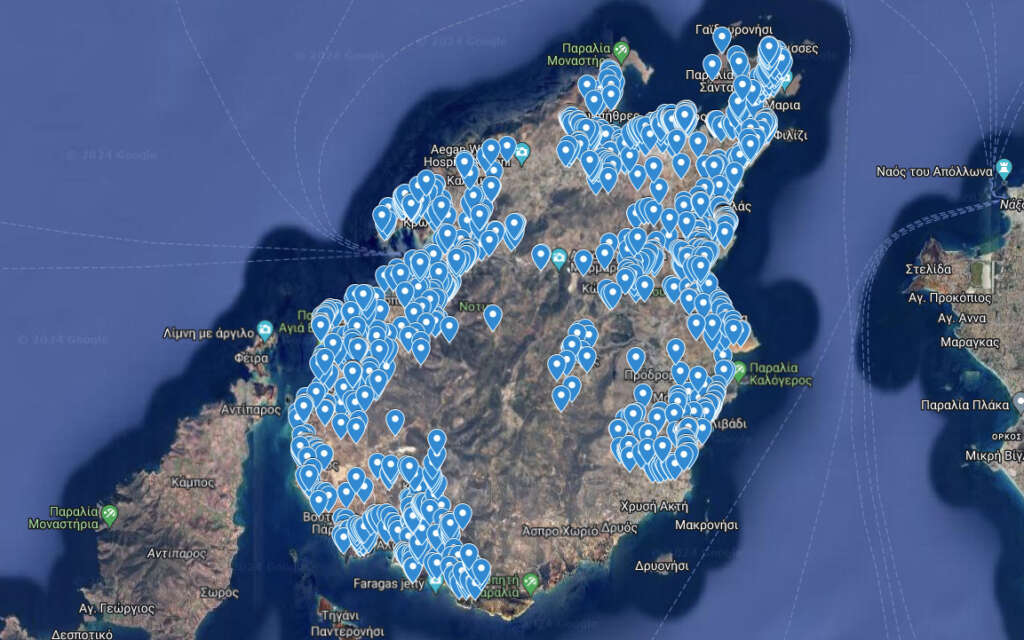
An independent audit using satellite imagery conducted by DigitalParos identified more than 1,480 swimming pools on Paros and 287 on Antiparos, far exceeding official figures. In some areas, for every declared pool, up to three “ghost” pools actually exist.

II) Environmental impact: water, chemicals, noise

  • Water consumption: A typical 40 m² private swimming pool consumes between 17,500 and 26,700 liters of water per summer season (90 days), with a median estimate of approximately 22,000 liters. This water is drawn entirely during the summer, at the peak of water stress, for purely recreational purposes. Across the island, the estimated 500 to 1,500 pools represent a total seasonal consumption of 11,000 to 33,000 m³—the equivalent of the annual consumption of 200 to 660 households.
  • On soil and marine quality: the chemicals used for pool maintenance (chlorine, algaecides, pH adjusters) seep into the soil during draining and rinsing, reach the groundwater, and, in coastal areas, the sea. On an island whose economy depends on the quality of its marine environment, this cumulative impact is far from negligible.
  • On local residents: pumps and filtration systems run 8 to 12 hours a day, generating continuous low-frequency noise. In the densely populated traditional villages of Paros, this noise pollution has a lasting impact on neighbors’ quality of life—an aspect rarely mentioned in public debate.
  • On hotels: the proliferation of private pools per room or suite represents an additional level of environmental irresponsibility. A hotel with 20 private pools generates a water usage impact equivalent to that of an entire residential neighborhood, for a guest experience that a single well-designed communal pool could just as easily provide.

III) The technical solution: rainwater is sufficient

FoPA points out that a typical villa in Paros (with a 150 m² roof) can collect up to 42,000 liters of rainwater per year, thanks to a standard collection system costing between €2,000 and €5,000. This volume exceeds the 22,000 liters needed to operate a swimming pool for a year, with a surplus that can be used for irrigation. There is therefore no technical justification for a swimming pool to draw on the drinking water supply. The recycling of graywater (from showers and sinks) can supplement this system for garden irrigation.

IV) The Proposed Regulatory Framework

FoPA proposes a set of concrete measures, structured across several levels:

a) For new swimming pools:

  • Maximum surface area of 1/10 of the lot, capped at 50 m² for residential properties
  • Ban on private swimming pools in hotels
  • Written consent from neighbors within a 25-meter radius
  • Mandatory report by a certified engineer on water management
  • Ban on forest land or land previously affected by wildfires

b) For existing unreported pools, a five-step regularization process is proposed: a one-time fine calculated based on the assessed value, an annual maintenance fee (50% of the initial fine until regularization is completed), regularization that extinguishes the fee, a permanent environmental contribution (reduced by up to 75% if water management equipment is installed), and—for recalcitrant owners after three years—a demolition order.

c) An annual environmental contribution applies to all swimming pools, with progressive reductions based on the level of water management infrastructure (rainwater harvesting, graywater recycling, chemical-free treatment).

V) Enforcement: DEYAP as the enforcement arm

FoPA proposes entrusting the enforcement of this framework to the municipal water authority (DEYAP), which already has real-time consumption data for each customer. Abnormally high consumption in the summer is a direct statistical indicator of an unmanaged swimming pool, detectable without a physical inspection.

DEYAP also has a direct interest in reducing discretionary demand, as every liter saved alleviates pressure on an already overburdened desalination system.

Periodic certification of water management systems is also proposed for all DEYAP customers—every two years for properties with swimming pools, every five years for ordinary residences, and annually for hotels.

In summary

FoPA is not calling for a ban on swimming pools, but for clear and structured accountability on the part of their owners. Rainwater harvesting, greywater recycling, reasonable size limits, and a permanent environmental contribution are, according to the association, the foundations of a viable coexistence between luxury tourism and the island’s ecological resilience. The message is clear: a swimming pool in Paros in 2026 should symbolize a responsible way of life here, not an ability to consume without limit.

Filed Under: English, Featured Articles, Members' and friends' contributions Tagged With: natural ressources, overconstruction, sustainable development, water by Orphée Vardos No Comments

Please don't forget to renew your membership
While 100% of donations are devoted to the cause for which they were donated, membership fees must cover the running costs of the association. We urge you not to delay yours!
~~~~~
N'oubliez pas de renouveler votre adhésion
Alors que 100% des donations sont consacrées à la cause pour laquelle elles ont été données, les cotisations des membres doivent assurer les frais de fonctionnement de l’association. Nous vous exhortons à ne pas retarder la vôtre !
~~~~~
Μην ξεχάσετε να ανανεώσετε τη συνδρομή σας
Ενώ το 100% των δωρεών αφιερώνεται στον σκοπό για τον οποίο δόθηκαν, οι συνδρομές των μελών πρέπει να καλύψουν τα τρέχοντα έξοδα του συλλόγου. Σας παροτρύνουμε να μην καθυστερείτε τη δική σας!

Reader Interactions

Leave a Reply Cancel reply

Your email address will not be published. Required fields are marked *

Primary Sidebar

  • E-mail
  • Facebook

Membership / Συνδρομή / Adhésion

Renew Your Membership or Join Us | Ανανεώστε τη συνδρομή σας ή γίνετε μέλος | Renouvelez votre adhésion ou rejoignez-nous

Give an Ancient Story a Second Life / Redonner Vie à des Voix Anciennes / Επαναφέρουμε Αρχαίες Φωνές

Findout more-En savoir plus-Μάθετε περισσότερα
Η Αρραβωνιαστικιά του Αχιλλέα

Upcoming Events

May 30
Featured 8:30 pm - 10:00 pm

Η Αρραβωνιαστικιά του Αχιλλέα

View Calendar

Recent Comments

  • Klio Kassimidis Curchod on Les piscines à Paros : un luxe que l’île ne peut plus se permettre
  • VALERIE P on Not one more bed on Paros
  • Lippmann on Pas un lit de plus à Paros
  • Catherine Jean on La zone humide de Santa Maria reprend vie avec les Flamants roses
  • Letourneau on Le projet de Kolymbithres revient — Les citoyens et les Amis de Paros et Antiparos s’y opposent à nouveau
  • Francina Lozada Nur on Not one more bed on Paros
  • FoPA on Ο υγρότοπος της Σάντα Μαρίας ξαναζωντανεύει με φλαμίνγκο
  • FoPA on La zone humide de Santa Maria reprend vie avec les Flamants roses
  • FoPA on The Santa Maria wetland comes back to life with flamingos
  • Alexandra Williams on Marathi Quarries: A Major Issue for the Island’s Environment and Heritage has arisen.
  • France Vaillancourt on Le projet de Kolymbithres revient — Les citoyens et les Amis de Paros et Antiparos s’y opposent à nouveau
  • Jan on The extension of Paros airport shows the way

Explore by Topic

airport animal welfare archaeology artists arts books civil society collaboration cultural heritage ecology entrepreneurship environment french monument fund raising campaigns gastronomy health history literature Marathi Quarries meeting with the mayor monasteries municipality natural heritage natural ressources open studios overconstruction overtourism parian marble paros impressions photography poetry proposal public debate quality of life recipes RES spatial plan sustainable development sustainable tourism theatre tourism unique cycladic character walking routes water wind turbines

Footer

About this e-bulletin

The e-bulletin of the Friends of Paros, in addition to announcements and news about the FoP’s activities, is a collection of all-types of articles about Paros.
It is aiming to share views, impressions, positions and proposals to an enlarged audience and to initiate a useful public debate around the many issues encountered on Paros.
You are encouraged to comment on articles and also to contribute with your own, a selection of which will be included in the printed version of the Bulletin of the FoP.
English, Greek and/or French is used and we have chosen not to have separate language versions to express our support for multiculturalism.
To become a contributor you need to register to the website.
Authors of existing articles can also register and acquire ownership of their articles for edits or improvements.
We would love to have your feedback and suggestions about the website!

Search

Categories

Paros Events

Tags

airport animal welfare archaeology artists arts books civil society collaboration cultural heritage ecology entrepreneurship environment french monument fund raising campaigns gastronomy health history literature Marathi Quarries meeting with the mayor monasteries municipality natural heritage natural ressources open studios overconstruction overtourism parian marble paros impressions photography poetry proposal public debate quality of life recipes RES spatial plan sustainable development sustainable tourism theatre tourism unique cycladic character walking routes water wind turbines

Copyright © 2026 · Magazine Pro On Genesis Framework · WordPress · Log in