• Skip to main content
  • Skip to secondary menu
  • Skip to footer
  • Home
  • Who we are
    • What we think
      • Positions
      • Members’ and friends’ contributions
    • What we do
      • Past-Campaigns
      • Upcoming Events
      • Annual Event
      • Past Events
        • General Assembly
      • Environmental Observatory
      • “PAROS 2020” & Tourism Survey
        • Paros Tourism Survey 2012
        • Paros Tourism Survey 2013
  • The Bulletins
    • 2023
      • E-Bulletin Issue 25 – 2023
    • 2022
      • E-Bulletin Issue 24 – Spring 2022
      • E-Bulletin Ιανουάριος/January/Janvier 2022
    • 2021
      • E-Bulletin Issue 23 – Autumn 2021
      • E-Bulletin Issue 22 – Summer 2021
    • 2020
      • Issue 21 – Year 2020
    • 2019
      • E-Bulletin Winter 2020
      • Issue 20 – Summer 2019
      • Issue 19 – Spring 2019
    • 2018
      • Issue 18 – Winter 2018
      • Issue 17 – Summer 2018
      • Issue 16 – Spring 2018
        • articles en francais
        • articles in english
    • 2017
      • Issue 15 – Winter 2017-18
        • articles en Français
        • articles in English
      • Issue 14 – Summer 2017
        • articles en Français
        • articles in English
      • Issue 13 – Spring 2017
        • articles en Français
        • articles in English
    • 2016
      • Issue 12 – Winter 2016-17
        • articles en Français
        • articles in English
      • Issue 11 – Summer 2016
        • articles en Français
        • articles in English
      • Issue 10 – Winter-Spring 2016
        • articles en Français
        • articles in English
    • 2015
      • Issue 09 – Summer 2015
        • articles en Français
        • articles in English
    • 2014
      • Issue 08 – Summer 2014
        • articles en Français
        • articles in English
    • 2013
      • Issue 07 – Summer 2013
        • articles in English
        • articles en Francais
    • 2012
      • Issue 06 – Summer 2012
      • Issue 05 – Spring 2012
    • 2011
      • Issue 04 – Summer 2011
    • 2010
      • Issue 03 – Autumn 2010
      • Issue 02 – Summer 2010
      • Issue 01 – Winter 2009-10
  • Workshops
    • Στρατηγικές για την Αειφορία 2023
    • Health on Paros / Υγεία στην Πάρο / Santé à Paros
      • Workshop on Health – 14.12.2019
      • Atelier sur la Santé – 14.12.2019
      • Ημερίδα για την Υγεία – 14.12.2019
    • Ancient Quarries Workshop
      • Conclusions
      • Conclusions (français)
      • Ομιλίες / Interventions
  • Current & older Issues
    • overconstruction
    • overtourism
    • Marathi Quarries
    • sustainable development
    • Sustainable Tourism
      • Στρατηγικές για την Αειφορία 2023
      • “PAROS 2020” & Tourism Survey 2012-2014
        • Paros Tourism Survey 2012
        • Paros Tourism Survey 2013
    • Airport
    • Wind Parks
  • Events

Friends of Paros & Antiparos Φίλοι της Πάρου & Αντιπάρου Amis de Paros & Antiparos

Sustainable development for Paros & Antiparos Islands

friends of paros & antiparos
  • Ελληνικα >>
  • Ποιοι Ειμαστε
    • Τι πιστευουμε
      • Θέσεις
      • Συμβολή μελών και φίλων
    • Τι κάνουμε
      • Ετήσιες Τελετές
    • Καμπάνιες
  • Τα “Bulletins”
    • 2023
      • Ε-Bulletin 24 – 2023 – άρθρα στα ελληνικά
    • 2022
      • Τεύχος 24 – 2022 – άρθρα στα ελληνικά
      • E-Bulletin Ιανουάριος 2022
    • 2021
      • Τεύχος 23 – 2021 – άρθρα στα ελληνικά
      • Τεύχος 22 – 2021 – άρθρα στα ελληνικά
    • 2020
      • Τεύχος 21 – Έτος 2020 – άρθρα στα ελληνικά
    • 2019
      • Χειμώνας 2019-20 – άρθρα στα ελληνικά
      • Τεύχος 20 – Καλοκαίρι 2019 – άρθρα στα ελληνικά
      • Τεύχος 19 – Άνοιξη 2019 – άρθρα στα ελληνικά
    • 2018
      • Τεύχος 18 – Χειμωνάς 2018 – άρθρα στα ελληνικά
      • Τεύχος 17 – Καλοκαίρι 2018 – άρθρα στα ελληνικά
      • Τεύχος 16 – Άνοιξη 2018 – άρθρα στα ελληνικά
    • 2017
      • Τεύχος 15 – Χειμώνας 2017-2018 – άρθρα στα ελληνικά
      • Τεύχος 14 – Καλοκαίρι 2017- άρθρα στα ελληνικά
      • Τεύχος 13 – Άνοιξη 2017- άρθρα στα ελληνικά
    • 2016
      • Τεύχος 12 – Χειμωνας 2016-17- αρθρα στα ελληνικα
      • Τεύχος 11 – Καλοκαίρι 2016- άρθρα στα ελληνικά
      • Τεύχος 10 – Χειμώνας-Άνοιξη 2016- άρθρα στα ελληνικά
    • 2015
      • Τεύχος 9 – Καλοκαίρι 2015- άρθρα στα ελληνικά
    • 2014
      • Τεύχος 8 – Καλοκαίρι 2014- άρθρα στα ελληνικά
    • 2013
      • Τεύχος 7 – Καλοκαίρι 2013- άρθρα στα ελληνικά
    • 2012
      • Τεύχος 6 – Καλοκαίρι 2012- άρθρα στα ελληνικά
      • Τεύχος 5 – Άνοιξη 2012- άρθρα στα ελληνικά
    • 2011
      • Τεύχος 4 – Καλοκαίρι 2011- άρθρα στα ελληνικά
    • 2010
      • Τεύχος 3 – Φθινόπωρο 2010- άρθρα στα ελληνικά
      • Τεύχος 2 – Καλοκαίρι 2010- άρθρα στα ελληνικά
      • Τεύχος 1 – Χειμώνας 2009-10 – άρθρα στα ελληνικά
  • Contact FoP
    • Membership application . Αίτηση Εγγραφής . Demande d’Adhésion
    • Register to contribute / Inscrivez-vous pour contribuer / Εγγραφείτε για να συμβάλετε
    • Login
  • Ημεριδες
    • Στρατηγικές για την Αειφορία 2023
    • Ημερίδα για την Υγεία – 14.12.2019
    • Ημερίδα για τα Αρχαία Λατομεία
      • Ομιλίες / Interventions
      • Τα συμπεράσματα της ημερίδας – Δελτίο Τύπου
  • Τρεχοντα ζητηματα
  • Εκδηλώσεις
Members' and friends' contributions » Despotiko: Archaeological and Restoration Works 2025

Despotiko: Archaeological and Restoration Works 2025

2 May 2026, by Ilia Daifa & Yannos Kourayos No Comments

Ελληνικά | Français
Antiparos, July 2025

Image 1: View of the Temple of Apollo following its restoration, the restaurant, and Building D

In Despotiko, the uninhabited island opposite Agios Georgios of Antiparos, where history and nature have coexisted harmoniously for centuries, the excavation and restoration program at the site of Mandra continues at an unrelenting pace this year as well—next to Petros Marianou’s goat pen, with its hundreds of goats.

Before the first test trenches by Yannos Kourayos in 1997 (then of the 21st Ephorate of Prehistoric and Classical Antiquities, now the Ephorate of Antiquities of the Cyclades) and the beginning of systematic excavation in 2001, no one could have imagined that nearly thirty years of research at Mandra and the nearby islet of Tsimintiri would so radically transform our understanding of the archaeological landscape of the Geometric and Archaic Cyclades.

To date, an extensive settlement spanning many centuries has been uncovered: 23 buildings, two large complexes, and a wealth of movable finds, most notably marble votive Kouroi. Within the settlement’s territory lie the large-scale building complexes on the islet of Tsimintiri, which in antiquity was connected to Despotiko by an isthmus.

At the core of the Archaic settlement lies the sanctuary of Apollo, covering 2,250 m², enclosed by a walled Peribolos with three gates (Image 1). On its western side stood the temple and the ceremonial dining hall; at its centre, the altar; and on the north side, the cult building D. South of the sanctuary were complexes that served the daily needs of the priesthood and visitors. The site’s high water demand was met by a well-organised system of cisterns. East of the sanctuary, along the route that visitors followed from the harbour, eight additional buildings and a circular tower have been uncovered (Image 2).

Image 2: Aerial photograph of the facility in Mantra and Tsimintiri. The tank system is visible at the bottom of the image.

The excavation continues to this day, adding new insights into the island’s history each year. Alongside Yannos Kouragios, the director of the Despotiko excavations, the dedicated team works systematically and with scientific precision to uncover and study the ancient treasures of Mandra: core team members Dr. Ilia Daifa and Dr. Alexandra Alexandridou; collaborating archaeologists Dr. Erica Angliker, Dr. Iphigeneia Leventi , Dr. Katerina Karakasi, Dr. Dimitris Palaiothodoros, Dr. Isabelle Algrain, Konstantina Fragkou, Dr. Manolis Petrakis, Dr. Angelos Matthaiou, Dr. Eirini Poupaki, Dr. Simon Davis, Dr. Erich Draganits, among others; architects Goulielmos Orestidis and Dr. Aenne Ohnesorg; marble craftsmen Vangelis Chatzis, Giannoulis Skaris, Giorgos E. Palamaris, Giorgos Kontonikolaou, Markos Armaos, Loukas Ioannou; conservators Giorgos Karampalis, Eva Tsavou, and Eleni Saiti; as well as the younger archaeologists Louiza Panopoulou, Kleopatra Papathanasiou, Eftychia Choumadaki, Lena Aslanidou, Eva Paraskevopoulou—and of course our tireless technician since 1997, Thodoris Velentzas (Image 3).

Image 3: The 2025 excavation team

Excavation Season 2025:

Image 4

The 2025 season began early, on May 18, with twenty students from Dartmouth College, USA, accompanied by Professor Paul Christensen and Dr Erica Angliker. A month of study followed at the museum storerooms, after which excavations resumed on June 22 and will conclude on July 11, 2025. In the second phase, under the supervision of Professor Alexandra Alexandridou of the University of Ioannina, twenty students from U.S. universities are participating through the College Year in Athens program.

Outside the Archaic sanctuary, excavation focused on “Building Ω”, where fragments of at least three Archaic Kouroi and the torso of a 5th-century BC statue were found embedded in secondary use during 2022–2023. Nearby lies Building MN, uncovered in 2023. This year’s work revealed additional walls belonging to at least two rooms and a large amount of pottery, shedding light on different construction phases.

Excavation also continued in the core of the settlement, specifically in the two large complexes south of the sanctuary—the Southern and the Eastern Complexes.

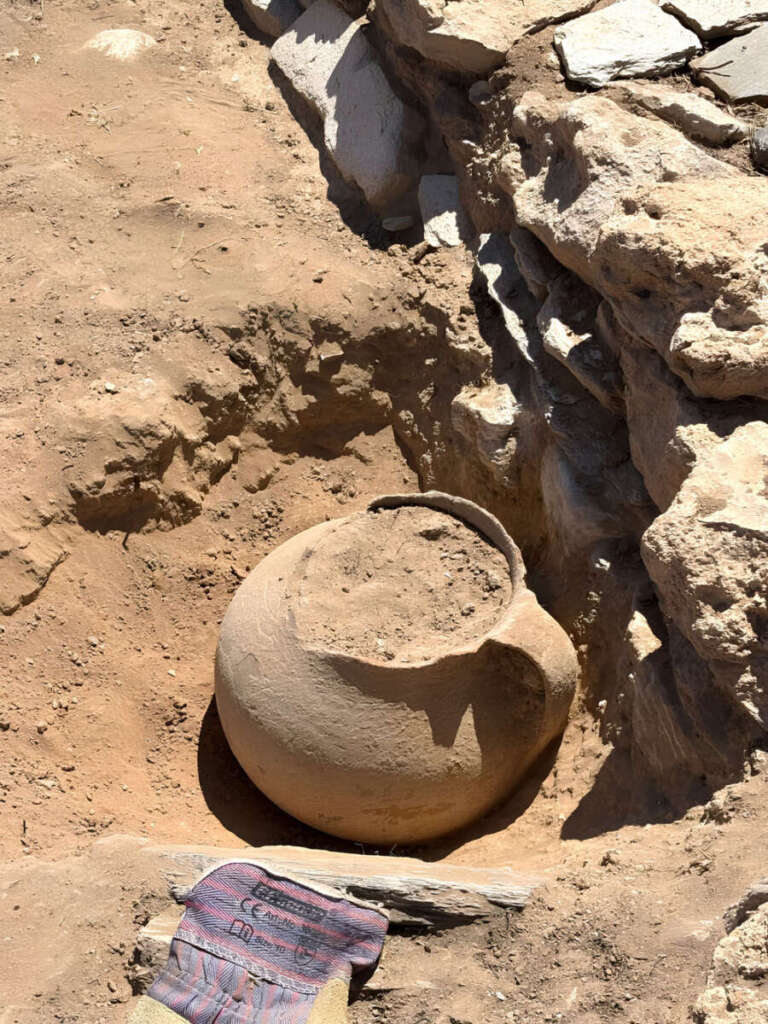
In the Eastern Complex, the southwesternmost room, which directly communicated with a large paved courtyard (Image 3a), was excavated to depth. A large cooking vessel was found in situ, carefully removed, and transferred to the museum for conservation.
Image 4: Cooking pot from a room in the South Complex

In the Southern Complex, excavation began southwest of the complex’s enclosure wall, revealing a new group of rooms apparently built in a later period, not connected with the main complex. Its limits are not yet defined, but findings within it will clarify its date and function.

One of the most significant discoveries in recent years is an extensive water-collection and management system, indicative of the sanctuary’s scale. It comprises cisterns and a built conduit extending along the hills south of the sanctuary. The construction of the large cistern and channel closely resembles the Archaic buildings of the sanctuary, likely dating to the 6th–5th century BC, the period of its peak activity, when water demand for the sanctuary, visitors, cultivation, and ships was high.

In 2025, research focused on the exploration of the large building complexes on Tsimintiri islet. Two large building complexes have been brought to light, featuring numerous rooms and courtyards, along with two circular structures and three smaller, separate buildings—all of which formed an integral part of the settlement at Despotiko. The easternmost of the two complexes covers an area of approximately 900 m², while the western one extends over at least 300 m². Between them stands a prominent circular structure with a diameter of nearly 16 meters, whose function remains unclear. Their location near the harbour, as well as the associated finds, suggest that these complexes were connected to the operation of the settlement’s port and to storage and commercial activities (Image 5).

Image 5: Aerial photograph of the Eastern Complex in Tsimintiri

Restoration 2025:

The Despotiko team’s responsibility extends beyond excavation to the protection and presentation of the site as an organised archaeological park. From 2014 to 2025, the program of restoration and enhancement of the Archaic sanctuary’s cult buildings has been implemented, with architectural studies by Goulielmos Orestidis.

The first step was the restoration of the temple and the ceremonial dining hall.

In 2022, restoration of Building D, the third-best-preserved structure in the sanctuary, began. After two and a half years, its restoration was nearly completed in June 2025, bringing the Archaic sanctuary closer to its ancient grandeur.

None of this would have been possible without the generous support of the project’s sponsors: AIGEAS AMKE (Thanasis and Marina Martinos), the P. & A. Kanellopoulos Foundation, the A. G. Leventis Foundation, the Friends of Paros and Antiparos Association, the Municipality of Antiparos, Marion Stassinopoulos, Irini and Nikolaos Lemos, the J. Latsis Foundation, Petros Pappas, Alpha Bank, College Year in Athens, and many other benefactors and friends of Despotiko. The excavation team expresses its sincere gratitude to all friends of Despotiko in Greece and abroad.

The research project at Despotiko is a dynamic, continuously evolving endeavour that each year reveals new buildings and significant finds. Combined with the restoration program of the sanctuary of Apollo, Despotiko stands today as a living archaeological site—an ever-evolving monument of history, unique in the Cyclades (Image 6).

Image 6: View of the temple from the south side, where the large auxiliary buildings are located

By Yannos Kourayos & Ilia Daifa – Despotiko Excavation and Restoration Team

Filed Under: English, Featured Articles, Members' and friends' contributions, Recent Articles Tagged With: archaeology, cultural heritage by Ilia Daifa & Yannos Kourayos No Comments

Please don't forget to renew your membership
While 100% of donations are devoted to the cause for which they were donated, membership fees must cover the running costs of the association. We urge you not to delay yours!
~~~~~
N'oubliez pas de renouveler votre adhésion
Alors que 100% des donations sont consacrées à la cause pour laquelle elles ont été données, les cotisations des membres doivent assurer les frais de fonctionnement de l’association. Nous vous exhortons à ne pas retarder la vôtre !
~~~~~
Μην ξεχάσετε να ανανεώσετε τη συνδρομή σας
Ενώ το 100% των δωρεών αφιερώνεται στον σκοπό για τον οποίο δόθηκαν, οι συνδρομές των μελών πρέπει να καλύψουν τα τρέχοντα έξοδα του συλλόγου. Σας παροτρύνουμε να μην καθυστερείτε τη δική σας!

Reader Interactions

Leave a Reply Cancel reply

Your email address will not be published. Required fields are marked *

Footer

About this e-bulletin

The e-bulletin of the Friends of Paros, in addition to announcements and news about the FoP’s activities, is a collection of all-types of articles about Paros.
It is aiming to share views, impressions, positions and proposals to an enlarged audience and to initiate a useful public debate around the many issues encountered on Paros.
You are encouraged to comment on articles and also to contribute with your own, a selection of which will be included in the printed version of the Bulletin of the FoP.
English, Greek and/or French is used and we have chosen not to have separate language versions to express our support for multiculturalism.
To become a contributor you need to register to the website.
Authors of existing articles can also register and acquire ownership of their articles for edits or improvements.
We would love to have your feedback and suggestions about the website!

Search

Categories

Paros Events

Tags

airport animal welfare archaeology artists arts books civil society collaboration cultural heritage ecology entrepreneurship environment french monument fund raising campaigns gastronomy health history literature Marathi Quarries meeting with the mayor monasteries municipality natural heritage open studios overconstruction overtourism parian marble paros impressions photography poetry proposal public debate quality of life recipes refugees RES sailing spatial plan sustainable development sustainable tourism theatre tourism unique cycladic character walking routes wind turbines

Copyright © 2026 · Magazine Pro On Genesis Framework · WordPress · Log in