
Insights and reflections following the visit to DEYAP – 17 September 2025
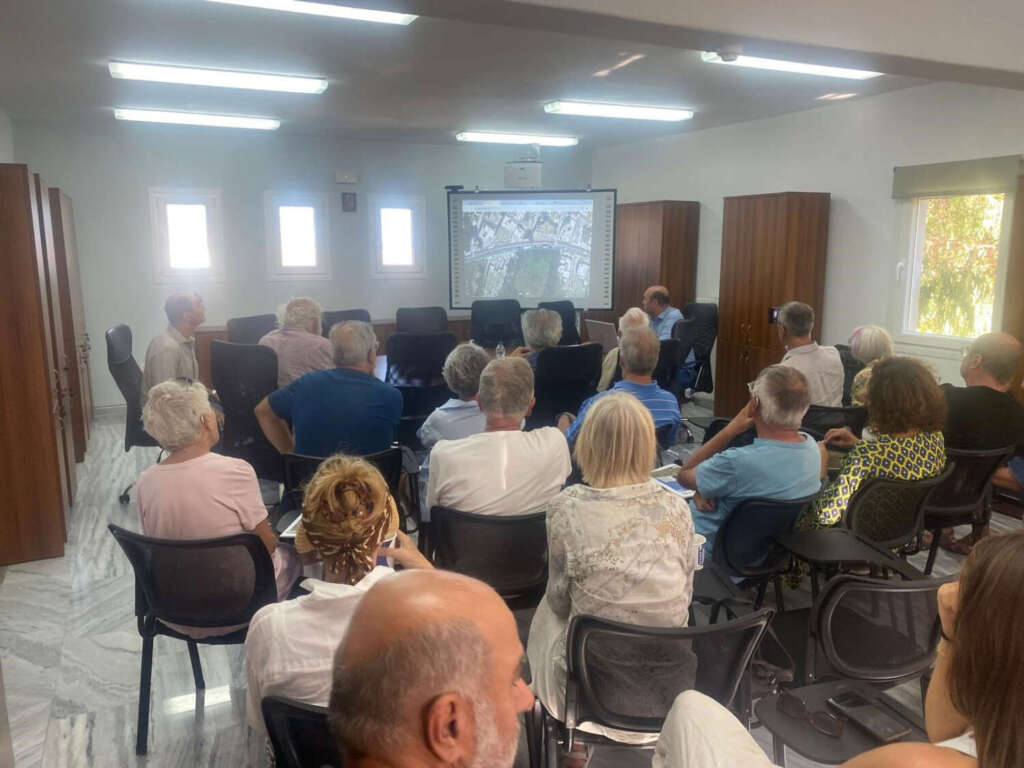
On 17 September 2025, members and sympathisers of Friends of Paros & Antiparos visited the facilities of DEYAP Paros, the municipal company responsible for water production, distribution and wastewater treatment on the island. We were welcomed by the Director Nikolaos Karamanes and Nikolas Skaramagas, Head of the Department of Consumer Affairs, who provided a transparent and technically rich overview of Paros’ water system.
DEYAP Paros operates and maintains the island’s entire water cycle, covering potable water production, storage and distribution, wastewater collection and treatment, and the development of energy-efficient and circular water solutions. The system currently supplies on the order of 2.5–2.6 million m³ of potable water per year, combining groundwater abstraction with reverse-osmosis desalination at Parasporos, while managing an island-wide distribution network whose efficiency is estimated at around 75%, a solid benchmark by Greek standards.
On the sanitation side, DEYAP operates three biological wastewater treatment plants (Parikia, Naoussa and Marpissa) with a combined design capacity of approximately 2,550 m³/day, and is developing projects at Tilegrafos/Akrotiri for treated sewage effluent (TSE) reuse and advanced treatment.
The organisation has invested significantly in digital metering and SCADA-based control, enabling real-time monitoring, leak detection and improved operational responsiveness.
Facing structural water scarcity and climate pressure, DEYAP is also planning capacity expansions, photovoltaic energy production and reuse schemes, positioning itself as a technically competent and reliable public operator. While key challenges remain—network losses, aquifer vulnerability, energy intensity and environmental impacts—the foundations are in place for a transition toward higher efficiency and more circular water use.
After a comprehensive presentation of Paros’ water-management system—its structure, key challenges and main components—the attendees visited the Tilegrafos (Parikia) facilities, where the photovoltaic, reverse-osmosis and treated sewage effluent (TSE) reuse projects were explained, before proceeding to Parasporos to learn about the reverse-osmosis desalination plant located there.
The visit confirmed both the scale of the challenges facing a Cycladic island under climate pressure and tourism growth, and the substantial efforts already undertaken by DEYAP. It underscored DEYAP’s solid, competent management; the robustness and reliability of its organisation; its customer-oriented philosophy; and its strong commitment to safe, dependable operations. DEYAP Paros is therefore well-positioned to ensure a secure and reliable water supply for the island’s residents.
At the same time, the visit made it possible to identify a number of structural gaps, where governance, regulation, and strategic choices will be decisive for Paros’ long-term water security.
In a spirit of constructive contribution—and not least as a way of thanking DEYAP for its openness and hospitality—we are keen to share below our insights and reflections on these issues.

1. Water Production: Desalination as Backbone, Not as a Panacea
Paros today relies heavily on seawater desalination, complemented by groundwater abstraction. The Parasporos desalination plant is currently operational, producing drinking water through reverse osmosis. A new desalination facility is planned in Akrotiri, with DEYAP considering doubling or even tripling desalination capacity in the Paros Bay area.
Desalination is indispensable, as groundwater potentials are limited. Yet it is energy-intensive, generates significant brine discharges, and should be viewed as a last-resort supply, not as a substitute for demand management, aquifer protection and reuse [1].
2. Network Efficiency: Digital Metering, SCADA and Leak Reduction
DEYAP explained that the new digital water meters are fully connected to its state-of-the-art central SCADA system (Supervisory Control and Data Acquisition). This allows near real-time monitoring of flows, pressures, and consumption patterns, and enables rapid intervention in the event of leaks or anomalies.
Thanks to these efforts, DEYAP estimates that the network currently achieves an efficiency rate of around 75%, meaning that roughly three-quarters of the produced water is effectively consumed. In the Greek island context, this is a solid benchmark performance and reflects sustained investment.
Nevertheless, international best practice shows that efficiency rates of 95% or more are achievable. Given that every percentage point of loss reduction saves both water and energy, Friends of Paros & Antiparos strongly encourage DEYAP to continue and intensify leak detection, pressure management and data-driven optimisation, building on the robust foundations already in place.
Improving network efficiency from 75% to 95% would reduce Paros’ water production needs by approximately 0.7 million m³ per year (≈ 2,000 m³/day), yielding substantial savings in water, energy and operating costs—comparable to adding a new desalination capacity, but without additional brine discharge. At a marginal selling price of €2.70/m³, this represents approximately €1.95 million per year (ex VAT), achieved with no additional operational cost beyond targeted network rehabilitation.
3. Groundwater: A Fragile Resource Without Island-Wide Governance
Although DEYAP is the largest single groundwater user on Paros, it is not legally responsible for supervising or regulating overall groundwater abstraction, nor is effective control exercised by the competent authorities. Yet DEYAP voluntarily limits its own pumping based on groundwater-level monitoring. According to its data, water tables in several locations lie as low as 40 cm above sea level, a threshold at which irreversible saline intrusion may become a serious risk.
The problem is systemic: no comprehensive public surveillance or enforcement mechanism currently exists to control total groundwater abstraction across the island. Responsible behaviour by one actor cannot compensate for unmonitored over-pumping by others.
We therefore advocate that DEYAP be formally entrusted—under public oversight—with an island-wide role in aquifer monitoring, coordination and regulation, including abstraction limits and data transparency. Aquifer protection is a collective interest and an intergenerational responsibility.
4. Smart Control of Consumption: From Data to Action
Digital metering creates opportunities beyond leak detection. With appropriate data analytics and artificial intelligence tools, near-real-time consumption data could be used to identify unusually high or abnormal usage, particularly by large or commercial users.
Such a system would allow graduated, targeted interventions: warnings, audits, temporary restrictions during stress periods, and—where necessary—strong financial disincentives. Price signals alone have proven insufficient; smart control enables active stewardship, not merely passive billing.
5. Rainwater, Greywater and Brown Water: Demand Reduction at Source
Paros currently imposes no general obligation for rainwater harvesting, greywater reuse or brown-water treatment. As a result, many gardens are irrigated with potable DEYAP water, an unsustainable practice.
We advocate a regulatory shift whereby all houses not connected to the sewer system would be required to install:
- rainwater harvesting and storage,
- septic or pre-treatment systems for brown water,
- reuse systems for rainwater, greywater and treated brown water dedicated to non-potable uses (notably garden irrigation).
Health concerns should not be overstated: when reuse is strictly excluded from food crops and limited to surface irrigation, this approach aligns fully with EU water-reuse principles and reduces uncontrolled infiltration into aquifers.
To ensure affordability and quality, an island-level framework contract with certified suppliers and installers could be negotiated, combined with subsidies for early adopters and penalties for late compliance. Such decentralised investments are likely to be more economical—and far more sustainable—than continuously expanding desalination capacity.
[1] Under EU law, the Water Framework Directive (2000/60/EC) requires Member States to ensure sustainable water management that protects aquatic ecosystems and achieves good ecological and quantitative status for all waters, including groundwater. This directive promotes economic instruments and cost-effective measures — such as demand management and reuse — to balance human needs with environmental protection. In addition, the Groundwater Directive (2006/118/EC) mandates measures to prevent deterioration of groundwater quality, including from over-abstraction. Together, these legal obligations support the primacy of demand management, aquifer protection and reuse over unbounded expansion of supply infrastructure. The relevant EU water legislation—namely Directive 2000/60/EC (Water Framework Directive) and Directive 2006/118/EC (Groundwater Directive)—has been transposed into Greek law primarily through Law 3199/2003(“Protection and management of waters”) and Presidential Decree 51/2007, which establish the principles of sustainable water management, prevention of deterioration and priority to demand management and aquifer protection. In addition, water reuse policies are supported by Regulation (EU) 2020/741, which is directly applicable in Greece.

6. Wastewater Reuse: From Irrigation to Potable-Quality Ambition
DEYAP plans to further polish its treated sewage effluent (TSE) at Akrotiri for sale as irrigation water. This is a sensible first step. However, in a water-scarce island context, potable-quality reuse should not be excluded.
Cities such as De Panne and Koksijde (Torreele project, Belgium), Singapore (NEWater), Orange County (California, USA), Windhoek (Namibia), and not in the least … London (UK, via long-standing indirect reuse through river augmentation) have demonstrated that advanced treatment of wastewater to drinking-water standards is technically safe and socially manageable when supported by robust governance and monitoring.
Compared with desalination, advanced reuse offers lower energy consumption, no marine discharge, and full control over water quality. Irrigation reuse should therefore be seen as a stepping stone, not an end point.
DEYAP operates three biological wastewater treatment plants on Paros—Parikia (≈1,200 m³/day), Naoussa (≈1,050 m³/day) and Marpissa (≈304 m³/day)—with a combined treatment capacity of approximately 2,550 m³/day. Assuming a conservative 70% average utilisation, this would yield around 1,790 m³/day of TSE. If further polished to potable standards with an equally conservative 85% recovery rate, this would result in approximately 1,500 m³/day, or 0.55 million m³ per year. At a marginal selling price of €2.70/m³ (ex VAT), this represents an annual economic value of approximately €1.5 million, with lower energy demand and without marine brine discharge.
7. Sludge Management: From Waste to Resource
The operation of Paros’ wastewater treatment plants also generates sewage sludge, which—based on our conservative assumptions—corresponds to an order of magnitude of 40–60 tonnes of dry solids per year, or roughly 160–300 tonnes per year of dewatered sludge cake, depending on dryness.
Rather than treating this stream as a disposal burden, Paros could develop a co-composting scheme, combining dewatered sludge with green and vegetal waste such as garden pruning, olive residues, landscaping waste and properly sorted market waste. When managed under controlled conditions and subject to routine quality monitoring (pathogens, heavy metals, permitted end-uses), such co-composting would transform sludge into a useful soil improver for landscaping and land restoration, reduce off-island transport and disposal costs, and further anchor Paros’ water cycle within a local circular-economy approach.
8. Desalination Brine: An Under-Assessed Environmental Risk
Desalination generates concentrated brine, representing roughly 60% of intake volume carrying the full initial salt load. In the Parasporos area, brine is discharged only a few hundred metres from the intake and approximately 50 m from the shoreline. At such proximity, it is legitimate to suspect potential re-entrainment under certain hydrodynamic conditions at the intake and accumulation of saline water in the discharge coastal zone, with consequences for both marine ecosystems and desalination efficiency.
Separately, the hydrodynamic configuration of Paros Bay raises concern. Dominant east–west currents are partially sheltered by the island, making it likely that flows slow, bend and form vortices, trapping brine within the bay instead of dispersing it into the open Aegean. This increases the risk of local accumulation, particularly in the Paros–Antiparos Strait.
Observed degradation of marine habitats – such as the disappearance of once-rich seabeds near Aghios Spyridon – warrants caution. While DEYAP states that it complies with existing regulations, it acknowledges that no in-depth, site-specific assessment of cumulative and long-range impacts has been carried out.
Given planned capacity increases, we strongly advocate:
- an independent environmental and hydrodynamic assessment of Paros Bay and the island’s western coastline, modelling salinity dispersion under current and planned intake and discharge configurations;
- verification of intake–discharge interaction;
- consideration of state-of-the-art offshore brine discharge solutions (on the order of 1 km offshore, subject to modelling).
It would indeed be regrettable to degrade Paros’ beaches and coastal ecosystems with brine, while simultaneously producing drinking water under sub-optimal, high-salinity conditions.
9. Environmental and Energy Considerations: Toward Carbon-Neutral Water Services
DEYAP Paros plans to install photovoltaic (PV) capacity to supply part of the electricity consumed by its operations—particularly desalination and pumping. This direction is fully aligned with climate objectives and should be strongly encouraged, with a clear ambition to move progressively toward 100% renewable electricity for water services.
Beyond PV alone, Paros could explore integrated energy–water storage solutions well suited to island topographies, including pumped-storage hydropower using water reservoirs.
Proven examples from El Hierro (Spain), Dinorwig (UK) and Okinawa (Japan) demonstrate that pumped storage is a mature and reliable technology where elevation differences, fluctuating demand and intermittent renewables coexist.
For Paros, such solutions could reduce reliance on fossil-based electricity imports, smooth the energy demand of desalination and pumping, and complement PV installations to approach carbon-neutral water production.
Conclusion
The visit to DEYAP revealed a technically competent operator working under intense pressure. Yet Paros’ water future cannot rely solely on supply expansion. Efficiency, governance, reuse, smart control and environmental precaution must now form a coherent, long-term strategy.
This is a top-tier priority, serving a public interest far greater than that of an airport expansion. Moreover, the investments concerned are fully eligible for European structural funding. Their implementation will not only secure the island’s long-term sustainability but also position Paros as a leading tourist destination in environmental responsibility.
Dirk Cortvriend, ir.
27/12/2026
Leave a Reply